


Sorry for the inconvenience.
Search again what you are looking for

Reference: Piikki GA050
Hydraulic Breaker Piikki line hydraulic breaker for 10...15 t excavators. Piikki breakers are hydraulic demolition rock hammer / pecker and they are gas assisted. For many daily applications, excavation assistance, demolition etc. Very simple and reliable structure, cost effective solution you can rely on. The Piikki Series is built for versatility, daily...
Reference: Piikki Pro 250
Hydraulic Rock Breaker Piikki Pro 250 (25...40) 2300 kg Piikki Pro line hydraulic breaker for 25...40 t excavators.. Piikki Pro hydraulic rock breakers are fully hydraulically operated. For mine and quarry applications, excavation assistance, demolition, tunneling, boulder breaking, underwater etc. The membrane type breakers are fully hydraulically...
Reference: Yellow G 05
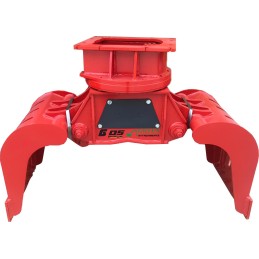
Demolition and Sorting Grapple Demolition and Handling Grapple Yellow G 05 (5…12t) (8 800 – 18 000 lb). Yellow line demolition and handling grapples designed for demolition and recycling applications. Structure of sorting grapple is light but robust which means energy savings and good productivity. Selector grabs for tough work Due to demolition and...
Reference: PB 10
Pilot boom PB for excavators Our range of PB pilot booms are designed for controlled pile installation. There can be a breaker or an auger mounted to the boom. Pilot Boom PB for Excavators is the ultimate solution for precise and efficient pile installation. Whether an auger or a breaker is installed, method of movement is same. There is an unit where...
Reference: Red AGR Pro 035
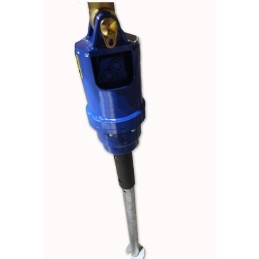
Hydraulic Auger Pro 035 AGR Pro line Hydraulic Augers for (2.0...5.0 t) excavators. AGR Pro hydraulic augers for excavators are designed for drilling holes, augers are an economical, robust solution for professionals. These earth drills can be used everywhere holes are needed by skid steer loaders, tractors, mini excavators, excavators, backhoe – loaders,...
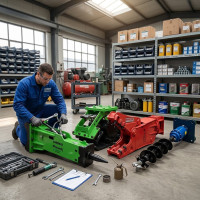
Excavator attachments are just as critical to job site productivity as the carrier machine itself. Hydraulic rock breakers, demolition grapples, rotating or fixed pulverizers, scrap shears, hydraulic augers, and other heavy-duty attachments endure immense daily stress, making wear and tear inevitable.
Routine annual maintenance is vital to preventing unexpected breakdowns, minimizing costly downtime, and significantly extending the lifespan of your excavator attachments.
While many contractors prioritize servicing their excavators, attachment maintenance is often overlooked. This oversight can lead to expensive repairs, production halts, and serious safety hazards on-site.
In this comprehensive guide, we provide a step-by-step annual maintenance checklist for excavator attachments and explain how proactive servicing maximizes your long-term return on investment (ROI).
Maintaining your excavator attachments is not a mere operating cost—it is an investment in your fleet's performance, durability, and total cost of ownership (TCO).
This checklist applies to most hydraulic excavator attachments, whether they are deployed in earthmoving, demolition, or the recycling sector.
The hydraulic system is the heartbeat of your attachments.
Hydraulic cylinders are constantly exposed to debris, dust, impacts, and moisture.
In demolition grapples, pulverizers, and other attachments featuring moving parts, pins and bushings are high-wear components.
The state of your wear parts directly impacts work efficiency and fuel consumption.
Heavy-duty tasks Subject attachments to non-stop vibration and extreme loads, especially in demolition and recycling applications.
Neglecting lubrication is one of the leading causes of premature equipment failure.
Most premature attachment failures stem from minor, easily preventable mistakes. Avoid these pitfalls:
While daily walkarounds can easily be handled on-site, advanced technical tasks are best left to the experts. Professional servicing is highly recommended for:
Hapetor provides professional attachment maintenance, genuine spare parts, diagnostics, and nationwide technical support for contractors across Finland. Partnering with a dedicated service specialist ensures that technical risks are identified before they spiral into catastrophic downtime.
Contractors often view maintenance solely as an immediate expense. In reality, an unexpected breakdown on the job site is vastly more expensive.
Example Downtime Cost Calculation:
If you add the premium for express spare parts delivery and emergency on-site technician call-out fees, a single breakdown can easily surpass €3,000. In contrast, a planned annual maintenance check costs only a fraction of that amount.
|
Maintenance Task |
Daily |
Monthly |
Annually |
|
Visual inspection & walkaround |
✓ |
||
|
Hydraulic leak checks |
✓ |
||
|
Lubrication and greasing |
✓ |
||
|
Bolt torque and tightness inspection |
✓ |
||
|
Wear parts assessment |
✓ |
||
|
Clearance and joint play measurement |
✓ |
||
|
Comprehensive condition inspection |
✓ |
||
|
Professional workshop service |
✓ |
Too many excavator attachments sit idle on job sites waiting for parts. Combining an optimized service schedule with a dependable spare parts supply chain is a cornerstone of smart fleet management.
By securing access to a robust parts inventory, contractors can:
Green Attachments offers a comprehensive stock of premium wear and spare parts, ensuring your tools can be serviced and returned to the field without delay.
The ultimate lifespan of an excavator attachment doesn't just depend on its rugged build quality; it is defined by the quality of its maintenance and the availability of genuine parts. When high-end attachments, authentic spare parts, and professional technical expertise come together, you achieve maximum equipment utilization and the lowest total cost of ownership.
Green Attachments engineers and supplies an extensive range of heavy-duty, professional-grade attachments—including premium hydraulic breakers, demolition grapples, rotating and fixed pulverizers, scrap shears, and hydraulic augers.
All maintenance, specialized repairs, and rapid component fulfillment are handled seamlessly by Hapetor Oy, keeping your operations running smoothly every day of the year.
How often should excavator attachments be serviced?
Daily visual checks must be performed before starting work every day, and an intensive annual service should be carried out at least once a year.
What is the most common cause of attachment failure?
Inadequate lubrication and undetected hydraulic leaks account for the vast majority of equipment breakdowns.
Can I replace wear parts on my own?
Yes, wear parts can be replaced by your team, provided you strictly follow the manufacturer's official instructions and guidelines.
How long does an annual attachment service take?
Depending on the size, complexity, and type of the attachment, it typically ranges from a few hours to one full working day.
Should I service a used attachment immediately after purchasing it?
Absolutely. Servicing it right away establishes a reliable baseline of the equipment's internal condition and operational safety.
Which attachments require the most frequent maintenance?
Hydraulic rock breakers, demolition grapples, pulverizers, and scrap shears experience the highest levels of structural stress and wear.
Can neglecting scheduled maintenance void my warranty?
Yes, in most cases, failing to follow the manufacturer's documented service schedule can void your warranty coverage.
How do I catch a hydraulic leak early?
Keep an eye out for visible oil pooling or stains on the attachment body, drop-offs in operating pressure, and uneven or sluggish tool behavior.
Search again what you are looking for