


Sorry for the inconvenience.
Search again what you are looking for

Reference: Piikki GA050
Hydraulic Breaker Piikki line hydraulic breaker for 10...15 t excavators. Piikki breakers are hydraulic demolition rock hammer / pecker and they are gas assisted. For many daily applications, excavation assistance, demolition etc. Very simple and reliable structure, cost effective solution you can rely on. The Piikki Series is built for versatility, daily...
Reference: Piikki Pro 250
Hydraulic Rock Breaker Piikki Pro 250 (25...40) 2300 kg Piikki Pro line hydraulic breaker for 25...40 t excavators.. Piikki Pro hydraulic rock breakers are fully hydraulically operated. For mine and quarry applications, excavation assistance, demolition, tunneling, boulder breaking, underwater etc. The membrane type breakers are fully hydraulically...
Reference: Yellow G 05
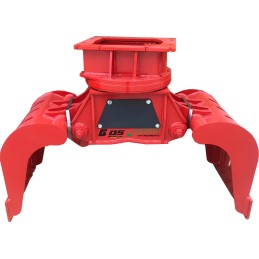
Demolition and Sorting Grapple Demolition and Handling Grapple Yellow G 05 (5…12t) (8 800 – 18 000 lb). Yellow line demolition and handling grapples designed for demolition and recycling applications. Structure of sorting grapple is light but robust which means energy savings and good productivity. Selector grabs for tough work Due to demolition and...
Reference: PB 10
Pilot boom PB for excavators Our range of PB pilot booms are designed for controlled pile installation. There can be a breaker or an auger mounted to the piling rig. Pilot Boom PB for Excavators is the ultimate solution for precise and efficient pile installation. Whether an auger or a breaker is installed to piling rig, method of movement is same. There...
Reference: Red AGR Pro 035
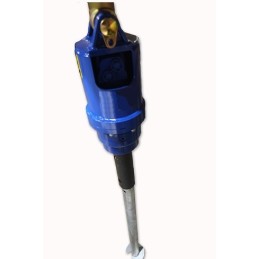
Hydraulic Auger Pro 035 AGR Pro line Hydraulic Augers for (2.0...5.0 t) excavators. AGR Pro hydraulic augers for excavators are designed for drilling holes, augers are an economical, robust solution for professionals. These earth drills can be used everywhere holes are needed by skid steer loaders, tractors, mini excavators, excavators, backhoe – loaders,...
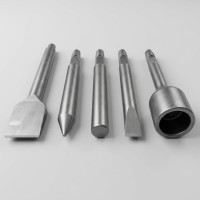
A hydraulic breaker can break concrete, split rock, remove asphalt and handle demanding demolition work. But the result depends just as much on the tool fitted to the breaker. The wrong tool may not break the material effectively, even if the breaker is perfectly matched to your excavator. The right tool makes the work faster, more controlled and easier on your equipment.
The three most common options are the moil point (also called a cone or pointed tool), the chisel and the blunt tool. This guide explains what each one does best and how to choose.
Quick answer: which tool for which job?
The right choice always depends on the material, your working method and the breaker you use.
1. Moil point: all the impact energy in one spot
The moil point concentrates the full impact force on a small area. A crack forms quickly, which is why this is one of the most common and versatile tool types.
Typical applications:
When is it not the best choice? For continuous breaking of large concrete structures, a chisel or blunt tool is often more efficient. Overloading the tip in very hard material can also wear it out faster.
2. Chisel: the versatile demolition tool
The chisel's wide working edge splits and breaks material in a controlled way. It is a strong all-rounder when the job is to separate and split rather than just penetrate deep.
Typical applications:
In concrete, a chisel works best when you first create a crack and then continue breaking around it.
3. Blunt tool: power spread over a wider area
A blunt tool has no sharp tip. The impact is spread over a larger area, so the goal is to break up and crush rather than to penetrate.
Typical applications:
A blunt tool is especially effective once a structure has already cracked and you want to reduce it to smaller pieces, for example to prepare material for concrete recycling.
Tool comparison at a glance
|
Tool |
Best for |
Typical materials |
|
Moil point |
Penetration and starting a crack |
Rock, frozen ground, hard concrete, stone |
|
Chisel |
Splitting and breaking |
Concrete, asphalt, masonry |
|
Blunt tool |
Crushing and heavy breaking |
Concrete, reinforced concrete, foundations |
Rule of thumb: rock and frozen ground → moil point. Splitting concrete and asphalt → chisel. Crushing concrete → blunt tool.
What else should you consider?
The tool is only one part of the whole setup. Even a large breaker will underperform if the tool doesn't suit the material. Before choosing, think about:
If you are still choosing the breaker itself, read our guide on how to choose the right hydraulic breaker for your excavator.
Never use the tool as a lever
The breaker tool transfers impact energy into the material. It is not designed for twisting or prying like an excavator bucket. Excessive side loading wears the tool and can damage the breaker as well.
A few practical tips:
Good technique extends tool life and keeps breaker performance consistent. If your breaker isn't hitting properly, the cause may lie elsewhere. See our troubleshooting guide: Hydraulic breaker not hitting properly.
When should you replace the tool?
A breaker tool is a wear part. A worn tool no longer transfers energy as efficiently as a good one. Check it if:
Checking the tool is also part of your annual attachment service and our maintenance guide. Always follow the breaker manufacturer's service and operating instructions.
Frequently asked questions
Which breaker tool is the most common?
The moil point is among the most common and versatile tools, widely used for breaking frozen ground and concrete.
Can I use several tool types with the same breaker?
Yes, provided the tool fits your breaker model and size class. Always check compatibility before ordering.
Which tool is best for concrete?
A chisel for splitting, a blunt tool for crushing thick or reinforced concrete. For very hard concrete, a moil point can help start the crack.
How do I know which tool fits my breaker?
Check your breaker model and the excavator weight class. If you're not sure, contact us and we will identify the right tool for you.
Find the right tool and spare parts at Green Attachments
Our range includes hydraulic breakers for every size class: Piikki, Piikki Pro and Red. Wear parts and spare parts are available for several brands:
Not sure which tool suits your job? Contact us with your breaker model, excavator weight class and application. We'll help you choose the right tool, with no guesswork.
Search again what you are looking for